Health & Safety Guide for Sumba
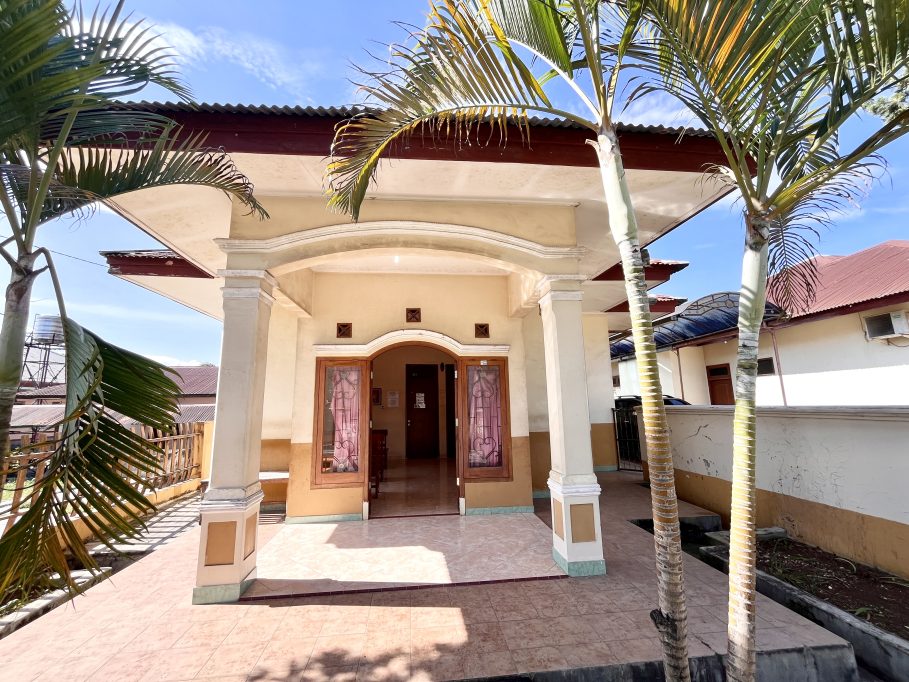
Sumba is a safe and welcoming destination. Crime is rare, and locals are genuinely friendly and helpful. However, as a remote island with limited infrastructure, visitors should be prepared and take sensible precautions. Most Sumba safety concerns relate to health (malaria, dengue), road conditions, ocean hazards, and the remoteness of medical facilities, rather than crime or personal security. With proper preparation and common sense, you will have a safe and memorable adventure.
Health Tips & Preparations
Healthcare infrastructure in Sumba is very limited, with only basic services offered. Therefore, you must prepare in advance to be ready to tackle any medical emergencies.
Pack the Essentials
Getting prescription medicines might be very difficult overseas. Bring a first aid kit including with anti-diarrhea medication and all the basic items, such as a strong mosquito repellant. Pack your prescription medications in original containers with copies of prescriptions, since finding a pharmacy that sells those could be difficult.
Recommended Vaccinations
Although they are not mandatory, we advise all visitors to get vaccinations for mosquito-borne diseases before their trip to Sumba. Get vaccinated only after consulting your doctor at least 6 to 8 weeks before your trip for recommended vaccinations.
- Japanese Encephalitis vaccine
- Malaria prophylaxis
- Tetanus-Diphtheria
- Pre-exposure rabies vaccination
Travel Insurance (Essential)
A comprehensive travel insurance with coverage for adventure activities, such as surfing, horse riding, and trekking, is essential for visiting Sumba. Make sure that your insurance coverage includes medical evacuation, since uninsured evacuation to Bali or Australia can cost $50,000+. Plus, getting coverage for lost or stolen items could help you recover financial loss in an unfortunate incident.
Standard policies may not cover motorbike accidents; check carefully and consider getting one if you’re planning to ride a motorbike. Print insurance documents and emergency numbers for accessibility even when offline.
Healthcare Facilities
Major towns in Sumba has private and public hospitals that treat both locals and visitors in most health issues. Small towns and settlements usually have community health clinics, called puskesmas, that offer very basic treatment.
| Place | Subcategory | Address |
|---|---|---|
| Apotik Sinar | Pharmacy | Bhayangkara street, Waikabubak district, West Sumba regency |
| Central Sumba Public Hospital | Public Hospital | Umbu Mamijuk, West Umbu Ratu Nggay district, Central Sumba regency |
| Christian Lindimara Hospital | Public Hospital | Jl. Prof. Dr. W.Z Yohanes No.06, PAYETI, WAINGAPU, Kota Kupang, Nusa Tenggara Tim. 87111, Indonesia |
| K-24 Pharmacy Waingapu | Pharmacy | D.I Panjaitan street, Matawai, Waingapu district, East Sumba regency |
| K-24 Waikabubak | Pharmacy | Bhayangkara street, Waikabubak district, West Sumba regency |
| Karitas Weetabula Hospital | Private Hospital | Jl. Bulgur No. 1, Kota Tambolaka |
| Lende Moripa Hospital | Private Hospital | El Tari street No. 2, Waikabubak district, West Sumba regency |
| Matanyira Malaria Clinic by the Sumba Foundation | Clinic | Matanyira village, Laboya Bawa, Lamboya district, West Sumba |
| Pratama Hospital | Public Hospital | Harona Kala, West Lamboya district, West Sumba regency |
| Puskesmas Mananga | Clinic | — |
| RSUD Waikabubak | Public Hospital | Adhyaksa street No. 11, Waikabubak district, West Sumba regency |
| Sinar 2 Pharmacy | Pharmacy | Langga Lero, Tambolaka district, Southwest Sumba regency |
| The Lende Moripa Doctor Clinic | Clinic | Jenderal Sudirman street, Waikabubak district, West Sumba regency |
| The Sumba Foundation Clinic | Clinic | Hoba Wawi village, Wanokaka district, West Sumba Regency |
| Umbu Rara Meha Public Hospital | Public Hospital | Jln. Adam Malik, No 54 Waingapu – Sumba Timur |
Medical Evacuation in Serious Illnesses
While medical facilities in Sumba offer basic medical treatment, evacuation might be needed for very serious cases, such as complex surgeries, serious trauma, advanced cardiac condition or severe infections requiring specialized treatment are the primary reasons for medical evacuation in Sumba.
Since Bali, Kupang and Java have more advanced medical services, patients may be transferred to one of the hospitals there. Medical evacuations are usually done by plane. In rare cases, helicopters or ferries might also be used.
Earthquakes
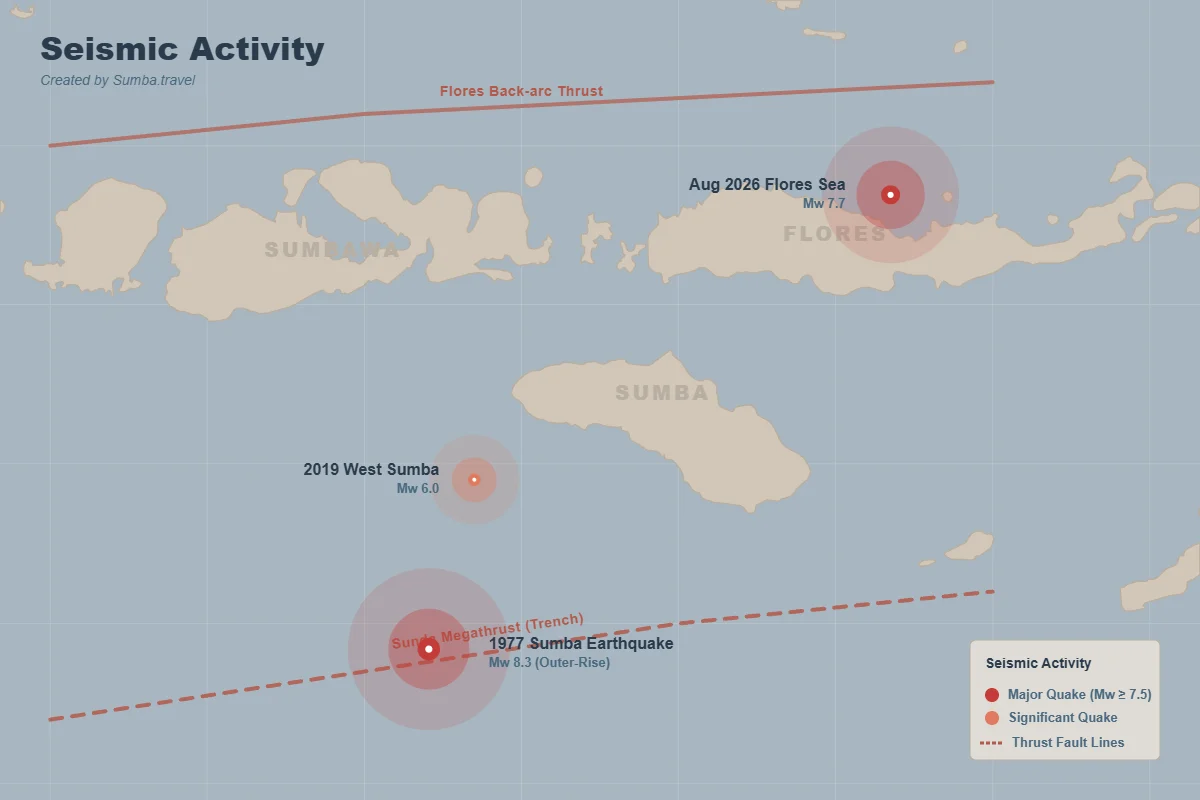
The entire island of Sumba sits within Indonesia’s Nusa Tenggara region, which is located directly along the active subduction boundary where the Indo-Australian plate subducts beneath the Eurasian plate. This makes the regional tectonic crust intensely dynamic and highly prone to frequent seismic shifting.
Earthquakes are exceptionally common in Sumba, with minor earthquakes and tremors happening almost daily. Official tracking data indicates that hundreds of small, low-magnitude earthquakes shake the immediate surrounding maritime straits and land territories annually.
Typical Magnitude
The typical daily magnitude ranges between 2.0 and 5.0, though the region is capable of much stronger, high-impact events.
| Routine Activity | Everyday crustal activity generally yields shallow, minor quakes averaging magnitudes of 2.0 to 5.0. These rarely cause damage or trigger tsunamis. |
| Historical Extremes | Major earthquakes happen infrequently. Sumba’s most famous historical event is the massive 1977 Sumba Earthquake, a powerful faulting shock that reached 8.3 in magnitude. |
| Recent Activity | In August 2026, a major 7.7-magnitude earthquake struck the nearby Flores Fault area, producing severe tremors felt strongly across Sumba and causing panic and temporary coastal evacuations. |
How to Stay Safe in an Earthquake
Drop immediately to your hands and knees to prevent being thrown down by violent shaking. Cover your head and neck under a heavy, sturdy piece of furniture like a solid table or desk. Stay far away from glass windows, dangling light fixtures, or heavy wardrobes that could tip over. Hold onto your shelter until all shaking completely stops. Do not run outside while the building is actively shaking.
Move directly into clear, open spaces far away from buildings, brick walls, power lines, and large trees. If you are operating a motor vehicle, safely pull over to an open area, like a park, and remain inside with your seatbelt fastened until the shaking subsides.
If you experience an earthquake on or near a Sumba beach that features severe shaking lasting 20 seconds or longer, do not wait for an official government broadcast warning. Run or walk rapidly inland (at least 2–3 kilometers) or head straight to elevated terrain that is at least 30 meters (100 feet) above sea level to protect yourself from a sudden tsunami wave.
Check yourself and those around you for physical injuries and apply basic first aid. Look out for secondary hazards like structural cracks, downed electrical lines, or broken utilities. If you smell a gas leak, open the windows and leave the structure immediately. Use SMS or text messaging rather than voice calls to communicate with loved ones, as local cellular towers will face severe network overloads. Expect multiple, rolling aftershocks to follow the primary earthquake event.
You can find more information about earthquake safety guidelines on the website of Centers for Disease Control and Prevention.
Evacuation & Emergency Assembly
Sumba has no globally designated permanent assembly spots; evacuations are managed dynamically by local authorities. Emergency responses, temporary shelters, and evacuation pathways are handled on the ground by Badan Penanggulangan Bencana Daerah (BPBD), the regional disaster management agency, alongside the national meteorological center, BMKG.
During a serious threat (such as the recent August 2026 earthquake), residents and visitors are directed by local officials and community safety networks to move out of coastal valleys or vulnerable structures toward designated open high grounds inland. Local government centers, sports fields, and elevated open public plazas are dynamically converted into makeshift safe zones.
Expats and visitors should closely monitor real-time disaster alerts via the official channels of the Indonesian Meteorology, Climatology, and Geophysics Agency (BMKG) or follow direct structural notices published via the Indonesian Humanitarian coordinator Platform (IDN HCP).
Mosquito-Borne Diseases
Mosquito-borne diseases are widespread in Sumba and often surge during dry season, when the weather gets warmer. Thankfully, avoiding them is quite simple, all you need to do is carry a repellent and get pre-vaccinated.
Malaria
Malaria is a disease caused by Plasmodium parasites, transmitted through the bites of infected female Anopheles mosquitoes, primarily in tropical regions. It occurs most frequently in two districts with the highest concentration of cases, namely East Sumba (particularly around Waingapu) and Southwest Sumba, with risk increasing significantly when you are in rural areas, forested regions, traditional villages, or locations near stagnant water where mosquitoes breed.
How to Avoid Malaria
Consult with a doctor at least two weeks before your trip to obtain preventive medication such as Malarone or Doxycycline.
Use high-quality DEET insect repellent (30-50%) at all times. Plus wear light-colored long-sleeved clothing and pants during dusk and dawn, when mosquitoes are most active
Ensure your accommodation has air conditioning, tightly sealed windows, and proper mosquito nets over your bed.
What to Do If I Show Symptoms?
If you have high fever that comes and goes, chills, excessive sweating, and extreme fatigue, you might have malaria. You should stay calm, do not panic and immediately visit the nearest Puskesmas (community health center) or hospital to undergo a rapid blood test for malaria. Please consult the healthcare facilities list we provided above.
If the doctor diagnoses you with malaria, you must strictly follow the antimalarial treatment and complete the full course of medication even if symptoms subside. Get plenty of rest while staying hydrated and taking fever-reducing medication like paracetamol, while avoiding further outdoor activities until you have fully recovered.
Good to Know
In case of emergency, if you are staying at a resort like NIHI Sumba, utilize their front desk staff and private medical team, and the Fair Future Foundation, which actively runs medical and malaria relief initiatives in East Sumba, may also provide guidance.
Dengue
Dengue is a viral infection that is spread from mosquitoes to people. It is more common in tropical and subtropical areas than in temperate climates. Early diagnosis is essential in treating dengue. While there is no specific treatment, it can be managed with medication such as paracetamol (acetaminophen).
Use Mosquito Repellent
Like all other mosquito-born diseases, dengue can also be easily prevented by using a strong mosquito repellent.
If You Show Any Symptoms
Head to the nearest medical facility if you experience high fever, severe headache, pain behind the eyes, muscle and joint pains, nausea, vomiting, swollen glands, and rash.
Wildlife
Wildlife is rarely a threat to visitors in Sumba. There are no large dangerous predators on land and most of Sumbanese wildlife is harmless. However, you should still beware of snakes, jellyfish and stray animals.
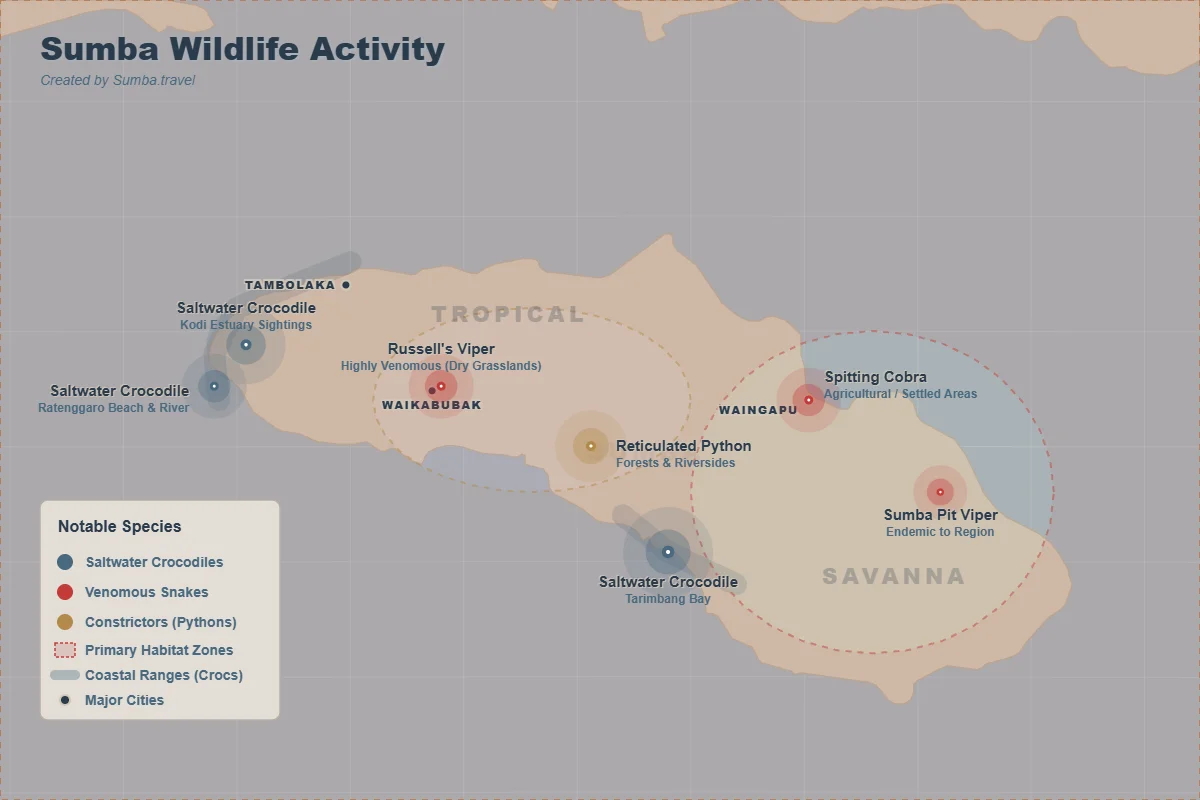
Snakes
While there are snakes on Sumba, bites are quite rare and mostly happen in forests, agricultural fields and dense bush during the rainy season. Since snakes are usually active at night, most bites occur during this time.
Snake bites in Sumba can be extremely dangerous and potentially fatal, as the island is home to several highly venomous species, most notably the White-lipped Island Pitviper (Trimeresurus insularis), also known as the white-lipped island pit viper.
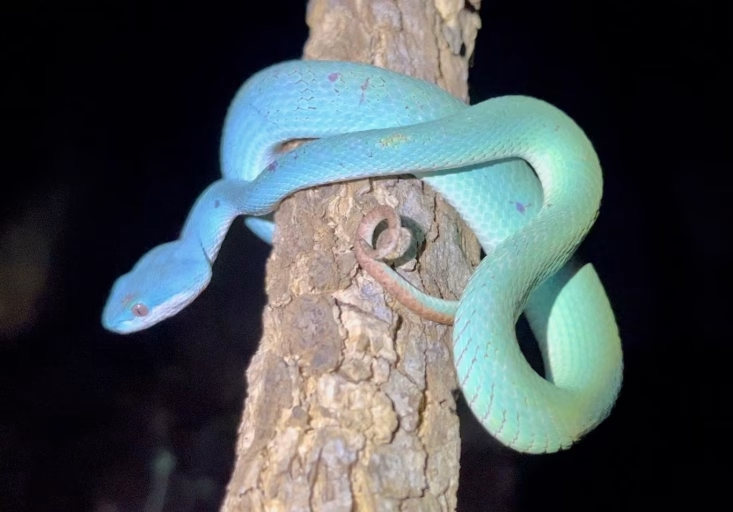
White-lipped Island Pitviper
White-lipped Island Pitviper, also known as the Eastern Tree Viper, (Trimeresurus insularis) is one of the venomous species of snakes on Sumba.
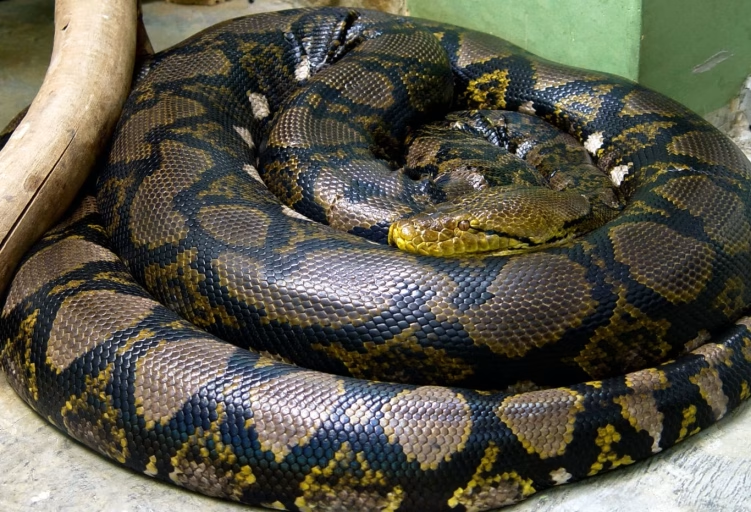
Reticulated Python
Reticulated python (Malayopython reticulatus) is a non-venomous snake usually found in rural areas. While it does not actively seek humans, deadly encounters occur.
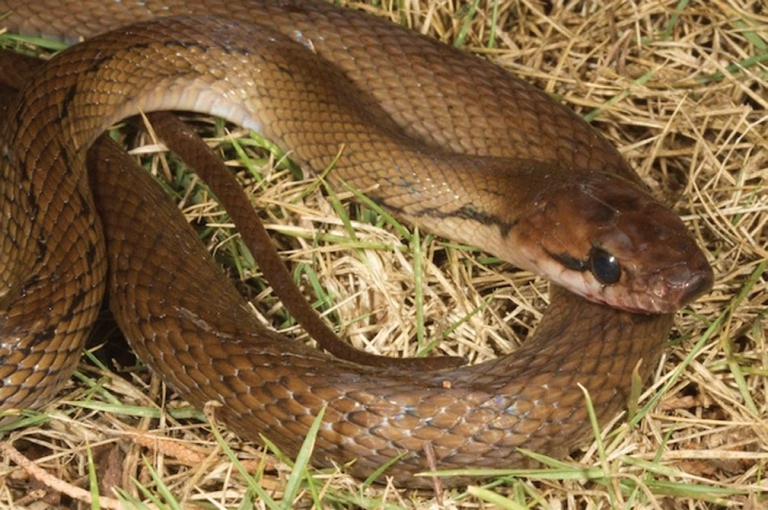
Indonesian Ratsnake
Indonesian ratsnake (Coelognathus subradiatus) is a very common and benign species on Sumba. They can bite for defence but are non-venomous.
You can avoid snake bites by staying out of areas with heavy undergrowth where snakes often hide and to carry a walking stick when trekking. If you or someone else is bitten by a snake in Sumba, the key to treatment is keeping the bitten area completely still to prevent the venom from spreading to the rest of the body and seeking immediate medical attention at the nearest Community Health Center (Puskesmas) or hospital.
Healthcare Facilities for Snake Bites
Hospitals and clinics listed below are likely to have snake antivenom in their inventory; in case of a snake bite, contact them as soon as possible for assistance.
RSUD Waikabubak (West Sumba)
JL. Adhyaksa, Kilometer 3, Kelurahan Dira Tana (atau Sobawawi), Kecamatan Loli, Kabupaten Sumba Barat, Nusa Tenggara Timur
(0387) 21701
RSUD Reda Bolo (Southwest Sumba)
Jl. Welonda, Desa Watukawula, Kecamatan Kota Tambolaka
085133703815
RSUD Umbu Rara Meha (East Sumba)
JL. Adam Malik No. 54, Kembala, Kambajawa, Kota Waingapu
(0387) 61302
RSUD Sumba Tengah (Central Sumba)
JL. lintas Waihibur, Desa Umbu Mamijuk, Kecamatan Umbu Ratu Nggay Barat
0822-1334-7853
RS Karitas (Southwest Sumba)
Jl. Bulgur No. 1 Kel. Waitabula, Keec. Kota Tambolaka
0387-2524027
081237279066.
Stray Dogs
Stray dogs are relatively common in Sumba, since they are seen as protectors of households. They often live in major towns and are generally tame. Still, you should avoid petting or approaching them, as they might be very unpredictable.
How to Respond when Bitten
Close contact with stray dogs might end up with you getting bitten. In order to prevent this unwelcome occurrence, we recommend you against touching any dogs on the street. If you get bitten, you should follow these steps.
If you or someone else is bitten by a dog, immediately wash the wound with soap and running water for 15 minutes.
Sumba Island is a rabies-endemic area and it is absolutely imperative to receive rabies vaccine after getting bitten. Below are the major hospitals you can contact and visit for the treatment:
- RSUD Umbu Rara Meha Waingapu (East Sumba)
Jl. H. Adam Malik No. 54, Kambajawa, Waingapu City
(0387) 61302 - Lende Moripa Christian Hospital (West Sumba)
Jl. El Tari No. 2, Waikabubak City
(0387) 61302 - RSUD Umbu Rara Meha (East Sumba)
JL. Adam Malik No. 54, Kembala, Kambajawa, Kota Waingapu
(0387) 61302 - RSUD Waikabubak (West Sumba)
JL. Adhyaksa, Kilometer 3, Kelurahan Dira Tana (atau Sobawawi), Kecamatan Loli, Kabupaten Barat, Nusa Tenggara Timur
(0387) 21701 - RSUD Sumba Tengah (Central Sumba)
JL. lintas Waihibur, Desa Umbu Mamijuk, Kecamatan Umbu Ratu Nggay Barat
0822-1334-7853 - RS Karitas (Southwest Sumba)
Jl. Bulgur No. 1 Kel. Waitabula, KEec. Kota Tambolaka
0387-2524027
081237279066.
Make sure to start getting the vaccine. If it’s your first vaccination, multiple rounds of rabies shots may be required, extending beyond your stay in Sumba. So, document your treatment to continue after your trip.
Try to document the time and place you got bitten for officials to monitor the area.
Avoid Contact with Stray Animals
Dog attacks usually happen in rural areas of Sumba and most of the time they occur due to direct contact with a stray animal. You can avoid such incidents by being cautious when outside of large urban areas and keeping distance with stray animals. Do not pet dogs, cats, or monkeys.
Take Dog Bites Very Seriously
Dog bites are extremely dangerous on Sumba Island due to the recent increase in rabies cases. Given that the disease attacks the central nervous system and is fatal, every dog bite must be taken seriously.
Jellyfish Sting
Jellyfish stings in Sumba happen most frequently in open coastal waters, estuaries, or river mouths, especially during the transition season or rainy season when ocean currents push jellyfish closer to shore, putting swimmers, surfers, and snorkelers at higher risk in these locations.
How to Easily Avoid Getting Stung
Always wear protective clothing such as long-sleeved rash guards, wetsuits, or stinger suits when swimming or snorkeling in unfamiliar waters.
Avoid swimming near river estuaries, river mouths, or areas with thick seagrass, as marine life often gathers there and attracts jellyfish to the vicinity.
Jellyfish stings in Sumba are generally considered mild and only cause localized burning and itching, however it is important to note that deadly species such as the Box Jellyfish can be found in Indonesian waters, so you should always remain vigilant and cautious, as stings from these species can be life-threatening and require immediate emergency medical treatment.
What to Do when Stung by Jellyfish
Immediately rinse the sting site with saltwater (seawater) and never use fresh water, as it can trigger the stinging cells to release more toxin.
If any tentacles are attached to your skin, carefully remove them using tweezers or protected fingers. Do not scrape with a credit card or sand, as this will actually worsen the sting.
If the pain is excruciating and there is a long way to the hospital: try to find hot water at 45°C (113°F) and soak the affected area in it for 20 minutes to deactivate the venom. If hot water is unavailable, you can use vinegar.
Head to a clinic or hospital immediately if the sting covers a large area, is on the face or neck, or if the victim experiences severe pain, dizziness, or difficulty breathing. None of the pain-relieving methods above are actual treatments. Jellyfish stings can release various toxins that might cause health issues.
Coral Cuts
Coral cuts in Sumba happen most frequently in shallow reef zones, rocky surf spots, and coral flats, particularly when walking without footwear or when surfing or swimming over exposed reefs during low tides. They are usually mild inconveniences that affect your quality of life for a short time. However, large or infected cuts can quickly become fatal.
How to Avoid Coral Cuts
Avoid walking or surfing over reef areas when the tide is low and coral is exposed, as these sharp structures can easily lacerate your skin and introduce harmful marine bacteria.
Wear protective reef booties and rash guards while in the water to minimize the danger.
Make sure to bring a personalized medical kit with supplies you may not find in Sumba pharmacies, including medical-grade iodine, broad-spectrum antibiotics like Doxycycline for marine infections (available by prescription only), and elastic bandages.
How Serious Are Coral Cuts?
Coral cuts can be serious because they are highly prone to infection, with coral fragments embedding in wounds and causing slow-healing ulcers (taking 3-6 weeks), cellulitis, and significant tissue damage if left untreated, so even a small-looking cut should never be ignored.
What to Do If I Have a Coral Wound
Leave the water immediately as seawater is full of bacteria that poses a significant infection risk to an open wound.
Use clean bottled water; avoid using stillwater or seawater.
Use sterile gauze and mild soap to gently but firmly scrub the wound to remove hidden microscopic pieces of coral dust and marine slime.
Use a medical-grade antiseptic like Povidone-iodine on the wound. Avoid rubbing alcohol, which can damage open wounds.
Cover it with a sterile breathable bandage; ensure that the wound is not left open.
Watch the cut closely for signs of infection. Seek immediate medical attention if redness spreads, swelling increases, or you develop a fever.
Food & Water Safety
Eating in Sumba is generally safe. If you stick to reputable establishments, luxury hotels and well-known resorts, you have nothing to worry about.
Beware: Methanol Poisoning
Methanol poisoning is a serious concern all across Indonesia. This issue stems from certain suppliers substituting ethanol with methanol, a cheaper but toxic alternative, to reduce production costs for spirits.
Only drink at high-end resorts and try to avoid spirits at small venues. Do not drink home distilled drinks.
Fermented beverages, such as beer and wine, are usually the safest options.
Market-bought spirist are generally safe to consume. If you want to minimize the risk, only buy alcohol from convenience stores.
Personal Security
Sumba is a very safe destination and violent crime against tourists is extremely rare. Common sense and certain precautions can elevate your personal security greatly. Avoid going out at night, especially in rural areas, and beware of your surroundings. Of course, don’t be paranoid, as locals are friendly.
Serious Warnings
Indonesia has death penalty for drug trafficking. Absolutely zero tolerance, even towards visitors. So, do not carry any type of narcotics when traveling into or out of Indonesia.
Smoking in public buildings is illegal and prohibited. Violation of this law could get you fined up to IDR 50,000,000 (about $3,000).
LGBTQ+ travelers should be discreet since the island’s culture is very conservative and acts of affection might offend the locals.
While often tolerated, public displays of affection, even between married couples, are culturally inappropriate in Sumba.
Ocean & Water Safety
Swimming, diving, and surfing are the main highlights of Sumba. Nevertheless, it’s imperative to know the possible dangers and always take precautions.
Diving Safely
Never dive into waterfalls or natural pools without checking depth.
Avoid swimming during wet season, since water levels are usually higher and the sea is unpredictable then.
Strong ocean currents and undertows are common in Sumba, so, make sure to find a safe spot to swim. The best spots are usually private beaches near luxury resorts or hotels.
Swimming with Kids
Always keep children within arm’s reach near water. Swimming alone or during wet season might be dangerous. Most beaches, especially free or lesser-known ones, have no lifeguards or warning signs.
Warning: Jellyfish
Do not dive in areas with high jellyfish population; seek immediate help if stung by one.
Road Safety & Transport
Road safety is no doubt a very common concern among first-time visitors. While the island has public transportation, it is unreliable and renting a car is more convenient. Since most roads on Sumba are unpaved and poorly lit, you should always be careful when driving.
Sumba’s streets are safe for solo travelers and you will be rarely bothered when walking alone; be prepared for little kids asking for money or gifts. Locals are very hospitable and open to outsiders, yet, since most cannot speak English, communication might be difficult.
Driving in Sumba
If you want to drive yourself, you need a valid International Driving Permit (IDP) along with your government-issued driver’s license. Most rental services in Sumba are informal and they might not ask you to submit an IDP. However, police and other officials might want to see your permit. Failing to provide an IDP might incur serious fines.
When renting a car, make sure to check brakes, lights, and tires thoroughly before accepting any rental vehicle. Ensure that the rental car comes with a full tank and keep the tank above half as petrol stations can be 50+ km apart. Mobile signal might be very patchy; download offline maps before departing.
Drive defensively in Sumba; expect livestock, chickens, and children on roads at night. Avoid all driving after dark.
Hire a Driver
If you have the budget, hiring a driver is the best option, since they will be used to unpaved roads and unmapped routes. They can also help you communicate with the locals and advice you on critical matters.
Rentals, Fuel Stations & Mechanics in Sumba
Below, you can find a list of rentals, fuel stations and mechanics in Sumba. Click on ‘Contacts’ to see their address and contact numbers.
| Place | Address |
|---|---|
| Pertamina Anakalang | Anakalang, Katikutana district, Central Sumba regency |
| Pertamina Waikabubak | Bhayangkara street, Waikabubak district, West Sumba regency |
| Pertamina Waingapu Center | Adam Malik street, Hambala, Waingapu district, East Sumba regency |
| Tambolaka Pertamina | Radamata, Tambolaka district, Southwest Sumba regency |
| Travel Mario | Soeharto street, Tambolaka district, Southwest Sumba regency |
| Langga Lero Vehicle Wash | Langga Lero, Tambolaka district, Southwest Sumba regency |
| Cathy Julian Motor | Gajah Mada street, Waikabubak district, West Sumba regency |
| Imanuel Motor | Bhayangkara street, Waikabubak district, West Sumba regency |
| Asmi Motor | KM 04, Kambajawa, Waingapu district, East Sumba regency |
| Delta Motor | Bhayangkara street, Waikabubak district, West Sumba regency |
| Orens Motor | Matawai Amahu street, Kambajawa, Waingapu district, East Sumba regency |
| Aries Car Rental | Wailiang, Waikabubak district, West Sumba regency |
| Alfa Omega Car Rental | Ahmad Yani street No. 160, Waikabubak district, West Sumba regency |
| Jeri Car Rental | Wailiang, Waikabubak, West Sumba Regency |
| Patiala Bawa Motorbike Rental | Patiala Bawa, Lamboya district, West Sumba regency |
| Sumba Retreat Motorbike Rental | Kerewe beach, Patiala Bawa, Lamboya district, West Sumba regency |
| Megah Dealer Honda Waingapu | Eltari street No.11, Matawai, Waingapu district, East Sumba regency |
| Honda Dealership | Bhayangkara street No.72, Pada Eweta, Waikabubak district, West Sumba regency |
| Haji Samsung Used Motorcycles | Kalena Wano, Tambolaka district, Southwest Sumba regency |
| UD Nirwana Yamaha | D.I Panjaitan street, Matawai, Waingapu district, East Sumba regency |
Sun Protection & Hydration
Due to its tropical savanna terrain, Sumba has a warm and sunny weather, especially during the dry season. Equatorial sun is extremely intense; sunburn usually happens within 15-20 minutes, so, make sure to protect yourself from the heat.
Know Before You Go
Heat exhaustion symptoms are dizziness, nausea, and excessive sweating.
Communication & Connectivity
The recent introduction of Starlink significantly improved connectivity in Sumba, but mobile signal is still limited in rural areas.
Emergency Numbers
Emergency numbers work without SIM card if you have any signal. WhatsApp works better than calls in areas with weak signal.
Emergency Scenarios & Safety Contacts
It’s essential to know what to do in various cases of emergencies. Staying calm and acting carefully can help you get out of most situations.
Prevention is Better Than Cure
Most Sumba safety issues are preventable with proper planning. Get travel insurance, bring necessary medications, respect local customs, drive carefully, and stay hydrated. A little preparation goes a long way toward ensuring an accident-free adventure on this beautiful island.
Sumba Safety Contacts
| Service | Contact |
|---|---|
| Emergency (Police, Fire, Medical) | 112 (National Emergency) |
| Police | 110 |
| Ambulance | 118 |
| Main Hospitals | RSUD Waikabubak / RSUD Waingapu |
| Your Embassy | Contact your country’s embassy in Jakarta |
FAQ
Frequently Asked Questions
Everything you need to know about health and safety in Sumba.
Are there hospitals in Sumba?
Yes, there are hospitals in Waingapu, Waikabubak, Lamboya, Waibakul, and Weetabula.
Do all hospitals in Sumba treat foreigners?
Of course, all clinics in sumba serve foreigners. Private clinics and hospitals accept tourists and expatriates with a cash/self-payment system in advance. Make sure you ask for a detailed note and official medical report so that the cost can be claimed on your travel insurance.
What kinds of medical care are available on Sumba?
In Sumba, you can access to basic medical treatment, surgeries, childbirth facilities and emergency care. For anything that requires research and further diagnosis, you may need evacuation.
In what situations do people need to be evacuated to Bali or Java?
An evacuation could be needed for complex surgeries, serious trauma, advanced cardiac conditions, and severe infections requiring specialized treatment.
Are there pharmacies in towns?
Yes, there are pharmacies in Sumbanese towns. But their selection of medicines might be limited.
Is Sumba generally safe for travelers?
Yes. Sumba is generally considered safe for a traveler.
Are there areas tourists should avoid?
Travelers should be cautious when visiting very remote areas far from towns especially if traveling alone or without local guidance.
Are tribal tensions real or exaggerated?
It is often exaggerated. Historically, conflicts between villages could occur, sometimes related to land disputes or longstanding rivalries. Today, such conflicts are uncommon and usually limited to specific local disputes, and they rarely involve outsiders.
Is theft or crime common?
Petty theft can occasionally occur, but it is not widespread.
Is it safe to travel at night?
Travel at night is possible in town, but in remote areas can be more challenging due to limited lighting and road conditions.
What should I do if I have a serious accident (e.g., a motorbike crash)?
1) Call 112 (national emergency) or 110 (police). English support is very limited.
2) Get to the nearest hospital in Waingapu, Waikabubak, or Tambolaka for stabilization.
3) Immediately contact your travel insurance provider to activate medical evacuation if needed. Do not wait.
4) Notify your accommodation host, who can help with translation and logistics.